
From Innovation to Icon:
The Last Influence of Sarudhaaru Dhonmanik - S.D.M.
What is art?
Is it a framed picture hung in a gallery, or is it an exquisite sculpture on display at a museum? Could it be the vibrant hues of a sunset, or a smile on someone’s face? The flight of a songbird, or a tree dancing in the wind? How does a life that is lived on art look like? Does it make a man different? Could it impact the way he interacts with the world around him?
Sarudhaaru Dhon Manik (SDM as he signed his artwork, or Dhombe as he was affectionately called) was a man who breathed and lived art. Art can indeed be a way of life; if one observed his work over the years, it would become evident that with a simple shift in perception even the most ordinary thing is touched by something extraordinary. SDM dared to push the envelope further, exploring uncharted territories and returning with tales of wonder. It takes a person of great character, integrity and an unwavering commitment to their craft to dedicate their lives in its pursuit the way that he did.
During our conversation in 2019, his family and friends surrounded SDM, chiming in with stories and memories over evening tea as the sun set on that February evening. He was clearly cherished and treasured by those who knew him; it was palpable in the air around him. He was calm and collected, and spoke lyrically. Each conversation flowed like a poem studded with pearls of wisdom; one did not leave without an elevated perspective on life, living and humanity. In that brief time, we spoke at length and delved into philosophies about art, criticism and expression.
SDM hailed from a family of creators. Born in Malé on 1st January 1926 to parents Sarudhaaru Kaleygefaanu and Thuthu Manike, Ismail Ahmed (real name) was the eldest of three siblings. Like our ancestors who were expert craftsmen, proficient in lacquer work and intricate coral carvings seen in ancient Islamic relics, SDM’s father was known for his skillful carvings on tombstones and Arabic lettering. His maternal grandfather was renowned for his coral carvings and artwork.
Growing up around creativity, he was involved in and surrounded by the inventive process of creation since he was very young. At the tender age of 10, he drew and created a card set for the game of ‘fulus’ (police) that was played by local children at the time. He sold these packs for around 1rf or 50 laari back in the day. This was perhaps his first venture in making money by using his artistic talent, and would continue to pilot the way forward.
During his life, he had experienced many significant events that undoubtedly shaped him into the legendary artist he came to be. He lost both his parents at a young age, and grew up under the care of his grandmother and great aunt. He lived through the horrors of the 2nd World War and witnessed the formation of both the first and second Republic of the Maldives. The effects these events in both his personal life and the world had on him found their way into his art.
SDM began gaining recognition for his talent from as early on as 1940s. The ten-year period from 1943 to 1953, the peak of his youth, was when his talents started to blossom. Around the age of 15, he was involved in making portraits, drawing from real life sittings and by referencing photographs. As he progressed with his work, he was initially commissioned by his friends from affluent backgrounds. This in turn eventually led him to creating portraits for the Indian (Bhora) Traders who were stationed in the Maldives until mid 20th century. His most notable portraits include that of the last Maldivian king Mohamed Fareed, the first president of the Republic of Maldives Mohamed Ameen Didi and the second president, Ibrahim Nasir as well as the portrait of Queen Elizabeth.
Along came the 1970s, and it was the advent of tourism that truly allowed him to fully utilize his artistic skills in a professional capacity. SDM was the first to tap into the vast movement of souvenir art that was emerging in the country. The first souvenir t-shirt with a shark head on it was designed and illustrated by him. Among other notable achievements under his belt, he was also part of the team that designed and produced the first Maldivian currency notes. The notes were created using custom-made rulers and drawings in ink, an endeavor that took approximately around a year to finish.
Unbeknownst to SDM, during the course of his life, artists in Europe were experimenting with modern art styles such as surrealism, DADA and abstract expressionism. Meanwhile, an ocean away, albeit having no direct connection, SDM was tapping into that collective consciousness and energy, and in his work, you can see a reflection of many qualities of these art forms. His use of colours and techniques and the detail-oriented quality of his work continued to garner praise from other artists who observed it.
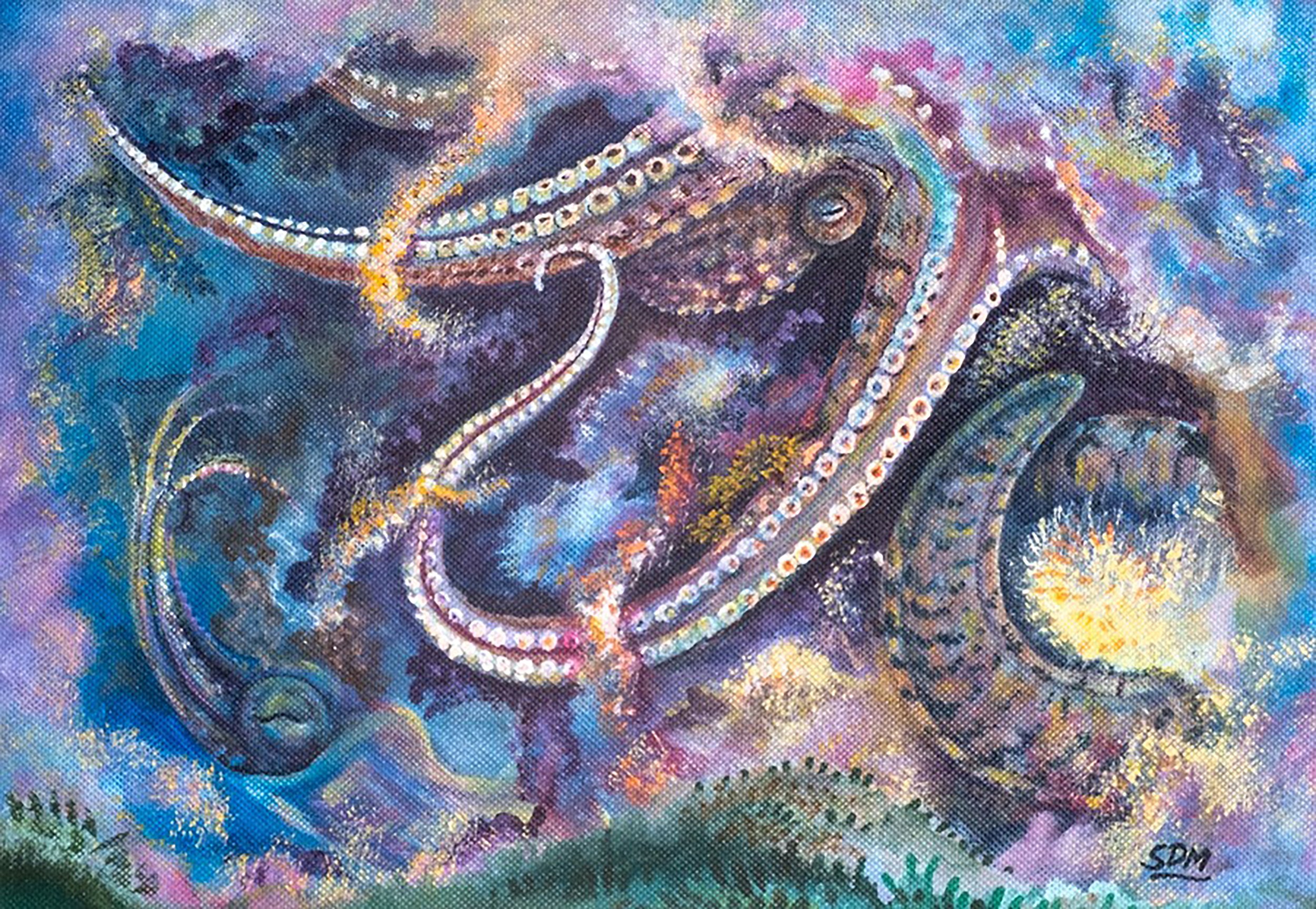
As the country’s first ever diver, the underwater world was evidently a source of endless inspiration for him. His interest in drawing the underwater world and the creatures in it was spurred by his diving and snorkeling undertakings. During his dives, he was presented with a world of colour, form and beauty that became his muse the moment he experienced it for the first time all those years ago. It would continue to inspire him throughout his long, illustrious career.
Without the use of any photographic assistance, SDM often relied on his memory to capture the underwater scenes he witnessed on his dive sessions. He would then later compose these scenes upon his canvases with details so intricate and sublime, relaying to viewers the immense splendour of the world beneath the ocean. The lack of catalogues at the time meant that he would catch and bring the fish and different types of shells back to shore with him to use as drawing references.
With his art, he had always strived to make something that may be of use, apart from aesthetic beauty. While those around him often urged SDM to explore abstract styles and to invoke his subconscious, his heart was set on a need to illustrate and show to people the wondrous sights he saw whilst underwater. As such, he maintained a meticulous documentation of the Maldivian marine life, illustrating one of the first posters of shells and fishes commonly found in the Maldives. An environmental aficionado, he was deeply passionate about and respected all living things, having once said in an interview, “even if a creature like a sea urchin could harm you, you can still admire and love it”.
Known by many as the Father of Art in the Maldives, SDM explored new routes, a trailblazer for those who would come after him. In doing so, he unlocked new doors for artists in the Maldives to pursue their artistic calling. He taught his craft to many others often from his own home and had travelled extensively around the country to teach handicraft. SDM was known to be an excellent tutor, selflessly sharing his knowledge and experience.
Art to him was not just drawing. He explained that art is poetry and expression. It is not static and can be found in the oceans, the skies, and even in the litter dusting the streets. Ultimately, it is all just a matter of perception. During our conversation, SDM spoke proudly of Maldivian artists and our rich history. He marveled at how Maldivians are and have always essentially been artists, with our seasoned craftsmanship visible in even the cutlery used daily at homes, artwork on kites, and the expertise displayed in boat building and stone carving.
A master of many mediums himself, SDM used pencil, oil, acrylic, watercolour, charcoal, sculpting, carving and papier-mâché in his work. He also drew on fabric, pillowcases and glass, created drawings for the magazines made using stamps and stencils, and made many a name boards for houses at the time. In keeping to the spirit of true innovation, he was known to experiment with these materials, enhancing his understanding of each medium and discovering new techniques and using them in his art. Be it melting glass for new creations or creating his own colours and brushes using whatever natural materials were available at the time when supplies were hard to come by, he was truly a pioneer. When the path was unclear, he made his own way, paving the way for those after him to follow.
SDM had produced a vast collection of work over his years as an artist. Having dedicated his life to art, he once said in an interview to aspiring artists the following words of encouragement: “Don’t ever let anyone discourage you from creating your art, and being successful at it.” This sentiment was reiterated in our conversation; wherein he urged young artists to use
the tools and equipment that are available to them at anytime to create art and diligently work forward. To overcome any hurdles and continue pressing on, because such is the nature of life. It remains up to us what we choose to do when faced with our individual obstacles.
Sarudhaaru Dhon Manik passed away on the 13th of March 2021. We mourn his passing as a great loss not only to the art community, but to the entire nation. SDM treaded the world fearlessly, following his innate curiosity and building a life that many after him would emulate and find deep inspiration in. On that evening in 2019, he ended our conversation with this beautiful advice to always view the world with an eye for joy: “Happiness comes from within and cannot be given to you or sought from someone else. Be tolerant and do not do to others what you do not want done to you.”